
What Smart Forms does
One form engine, four kinds of field work.
Paper forms and static PDFs are the weak link in field data — questions that don't apply, handwriting re-keyed later, no way to route a failed inspection until someone remembers to call it in. Smart Forms behaves like software: it adapts to what's entered, pulls known data instead of asking twice, and moves the next step along on its own.
The same engine runs every kind of field capture — and because field work doesn't stop where cell coverage does, it all works fully offline.
Built-in intelligence, not add-on logic.
HOW IT WORKS
Every form carries the same four capabilities — none of them require a separate tool or a workaround.
01 — LOGIC
Conditional show/hide logic
Follow-up fields appear only when the answer calls for them. Shorter forms, fewer wrong answers, and nothing irrelevant to scroll past on a phone screen in the rain.


02 — DATA
Data-driven dropdowns
Fields pull live from the asset registry and prior records — ID, location, history — instead of free text a technician has to remember or guess. Select the asset, and the form already knows it.
03 — ROUTING
Dispatch, escalation & multi-step workflows
A completed form can trigger the next step on its own: dispatch a work order, escalate a failed inspection, or route a regulatory form for sign-off — no one has to remember to follow up.


04 — OFFLINE
Offline-first field capture
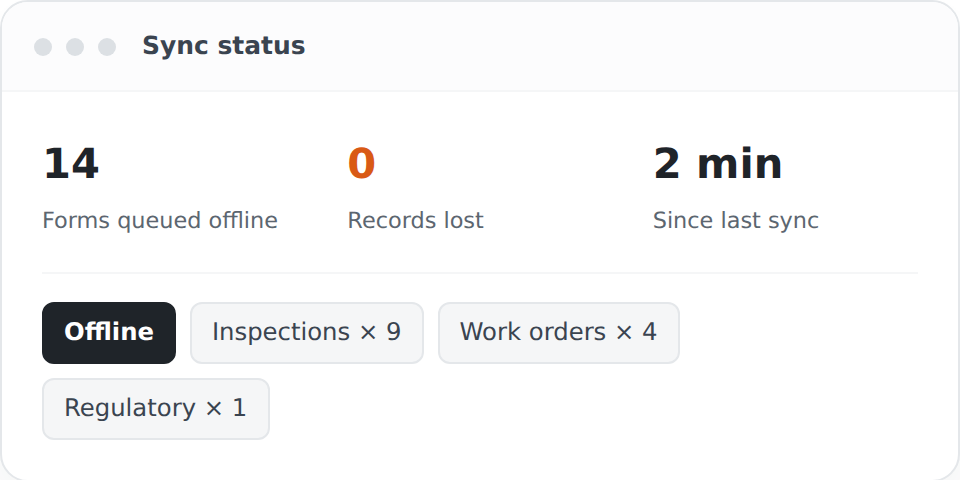
Forms work with zero signal — no internet, no cell data, no exceptions for remote sites. Everything syncs automatically the moment connectivity returns.
Built for your work
One engine, every kind of field form.
Field & regulatory inspections
Routine rounds and regulatory submissions run on the same conditional, data-aware form engine.
Work orders
Preventive and corrective maintenance forms pull equipment history straight from the asset record.
Testing
Capture mechanical integrity, engine stack, and well integrity results without a separate system.
Connects to
One form, feeding every module.

Triggers Workflow Automation
A form submission is a workflow trigger — dispatch, escalation, and sign-off all start from the same event.

Feeds Compliance & Emissions
Regulatory forms map directly to the requirement they satisfy, ready for reporting the moment they sync.
